
Prospective Students

Start Your PhD Journey with Harvard BBS
Harvard’s Biological and Biomedical Sciences (BBS) Program offers PhD training across the full spectrum of fundamental and applied life sciences. Our flexible curriculum will prepare you to work across a range of experimental platforms, from molecular to organismal scales and from wet-lab experimentation to cutting-edge computational analysis. As a BBS student, you will have access to an extraordinary array of resources: more than 800 faculty and their research programs, state-of-the-art core facilities, and a powerful alumni network. You will train in the heart of a world-leading biomedical ecosystem, surrounded by Harvard-affiliated hospitals and research centers and embedded in one of the largest biotech and biopharma communities in the world.
Research Communities
We think of these communities as intellectual neighborhoods within the BBS umbrella, each offering a close-knit environment where faculty and trainees with shared interests collaborate to advance their fields. Within these neighborhoods, you will engage in focused research, participate in enriching training activities, and build connections through a variety of social and community events. Student participation in these communities is completely optional, thus adding resources without constraints.
BBS Supporting Departments
These departments serve as academic homes that provide the faculty, laboratories, and resources that make the program possible, and they also share in the governance of BBS by shaping its curriculum, policies, and academic standards. BBS is an umbrella program rather than a standalone department, and the supporting departments form the foundational communities in which BBS students are trained, mentored, and guided throughout their doctoral studies.
Certificate & Enrichment Programs
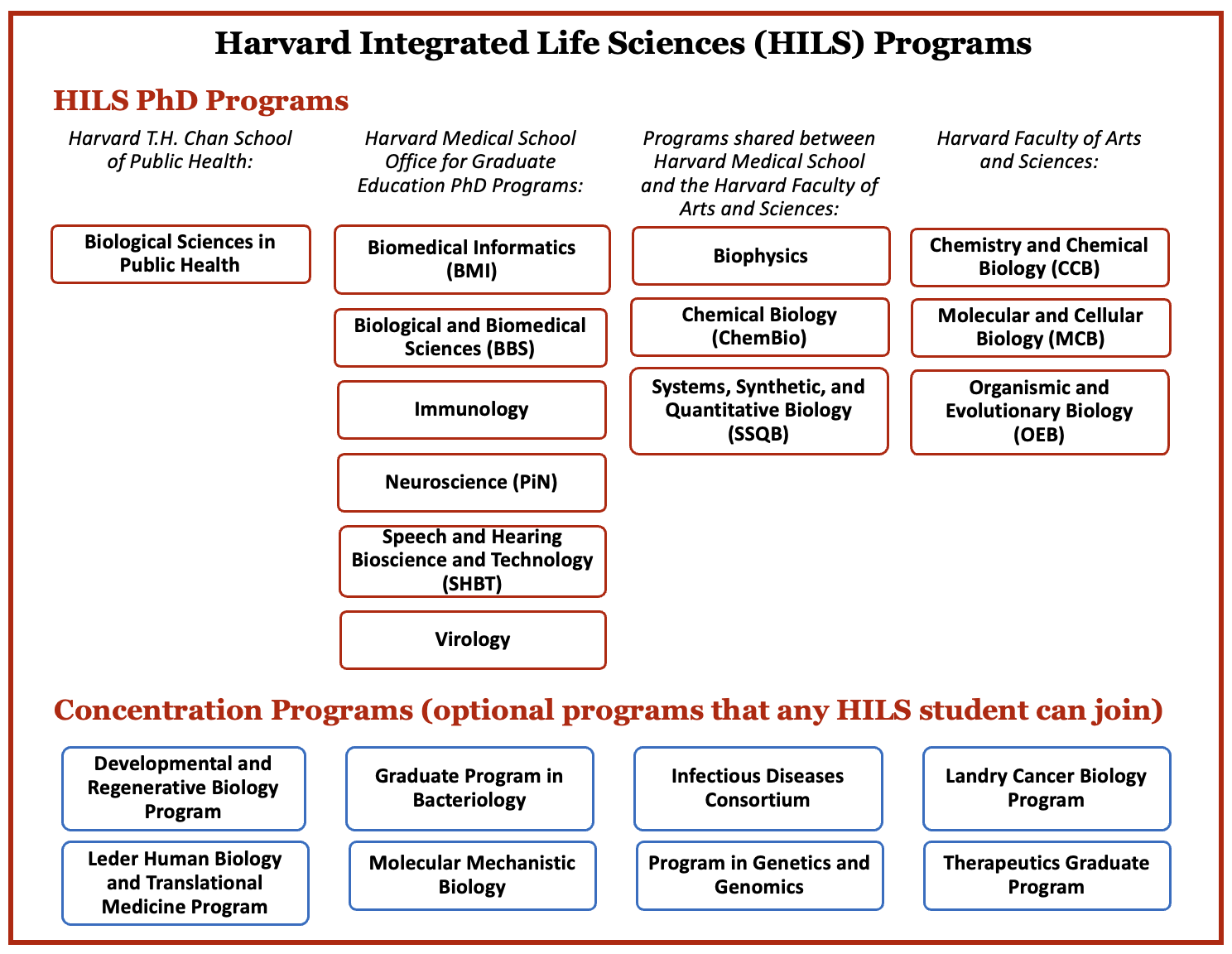
These programs allow students to become a member of more specialized communities that come together through shared intellectual interests. The rigor and commitment of these concentrations vary considerably, from no formal requirements whatsoever to an additional application process with course requirements that yield a certificate. Students may join one or more concentrations or none at all. Open to all HILS students.
Certificate Programs:
- Leder Human Biology & Translational Medicine (LHB) (Application Required)
- Therapeutics Graduate Program (TGP) (Application Required)
Enrichment Programs:
Student Support
Our program is built to support you at every stage of your Ph.D. journey. From the moment you arrive on campus and take part in first-year orientation, through lab rotations, coursework, qualifying exam, and independent research, our program provides comprehensive mentoring and resources tailored to each phase of your training. As you move toward your dissertation work and final thesis defense, you will continue to receive personalized guidance from faculty advisors, program staff, and peer mentors. Our dedicated team is committed to helping you thrive academically, professionally, and personally, so you can realize your full potential and emerge as innovative, confident scientific leader.
Financial Support
Our students receive full tuition and stipend support, as outlined in their financial aid offer, while they are enrolled and making satisfactory progress toward the Ph.D. degree. Upon matriculation to BBS, all students are given a one-time $1,000 relocation allowance. Students are also eligible to enroll in the Harvard University Student Health Program (HUSHP) and are not responsible for paying the yearly health fee.
Training Structure
Rotations & Joining a Lab
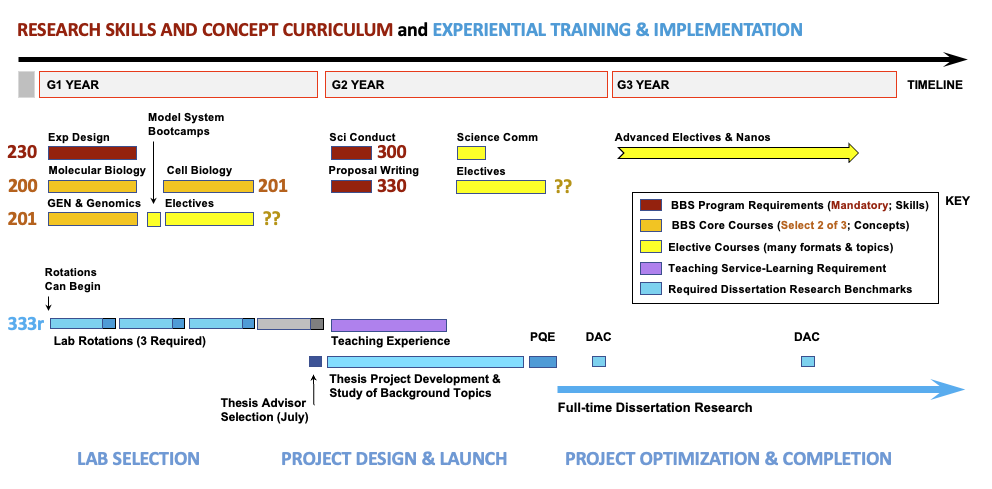
During their first year, BBS students complete research rotations in at least 3 different laboratories. Each rotation lasts a minimum of 8 weeks and no longer than 12 weeks, with no more than 3 weeks between rotations. By June 30 of the first year, students select their dissertation advisor. The faculty member who leads that lab becomes the student’s primary mentor for the remainder of their graduate training.
Curriculum
The BBS curriculum offers flexibility in both course topics and formats as students work toward their Ph.D. requirements. Students must complete a total of 28 course credits: 14 credits in Skills and Core Content courses and 14 credits in electives.
Teaching
Pedagogy (the strategies and techniques or “art” of teaching) allows the communication of scientific concepts, principles, methods and details for the training of others. Teaching is also a powerful vehicle to offer mentorship and encouragement to others. The BBS program requires that each student fulfill one semester as a non-paid teaching fellow primarily in BBS Core Courses.
Qualifying Exam
All students must successfully take and pass BBS330QC: Critical Thinking & Research Proposal Writing prior to taking their qualifying examinations. In BBS330qc, students work in small groups to develop a research proposal relevant to their thesis topic, which includes two specific aims. The qualifying exam will be based on the two aims developed during BBS330qc plus a third aim, derived outside of the course, which is specific to the PQE proposal. Exams are scheduled during the second half of the G2 year, from January through June.
Dissertation Advisory Committee
After passing the qualifying exam, students will select three faculty members to serve on their Dissertation Advisory Committee (DAC), joining their PI in overseeing their dissertation research. The first DAC meeting should be held within 3–4 months of successfully completing the PQE. Subsequent DAC meetings are required every 9 months, increasing to every 6 months once the student reaches G5 status or above.
Dissertation & Defense
A student's dissertation and defense is the final step in showcasing years of dedication, research, and intellectual growth. This pivotal moment allows students to present their findings, defend their methodology, and engage in scholarly discussions with their committees.
Average Time to Degree
Most students complete the program in 5½ to 6 years.
Alumni Careers
Our graduates pursue a wide range of impactful careers that draw on their scientific training, analytical skills, and commitment to discovery. Alumni go on to leadership roles in academic science and higher education, drive innovation in industry, shape policy and regulation, and translate research into new therapies, technologies, and ventures.
The paths below illustrate the breadth of opportunities our trainees pursue, from traditional research and clinical careers to roles in law, finance, consulting, government, communication, and beyond, demonstrating how a PhD from our program can be a foundation for many different ways of advancing science and society.
- Academic Administration
- Academic Education
- Academic Research
- Biotechnology/Pharmaceuticals
- Consulting
- Finance
- Government
- Law
- Medicine
- Science Policy
- Science Writing/Publishing
- Venture Capital
Harvard Integrated Life Sciences (HILS)
BBS is a member of the Harvard Integrated Life Sciences (HILS) Alliance, which includes 13 PhD programs across three Harvard faculties: the Faculty of Arts and Sciences, the T.H. Chan School of Public Health, and Harvard Medical School. As a HILS student, you gain access to University-wide training resources and facilities, along with a network of more than 800 affiliated faculty. HILS offers substantial flexibility, allowing you to take courses, complete laboratory rotations, and choose a dissertation advisor across participating programs.
Although students may apply to multiple programs, they are strongly encouraged to explore the options carefully and focus on those that best match their interests and goals. Below is an illustration of the Harvard HILS PhD landscape.
HILS Connections

GSAS Perspectives

Admissions Contact
Danny Gonzalez
daniel_gonzalez@hms.harvard.edu